


One of the biggest mistakes advertisers make is treating billboard advertising the same way they treat digital ads.
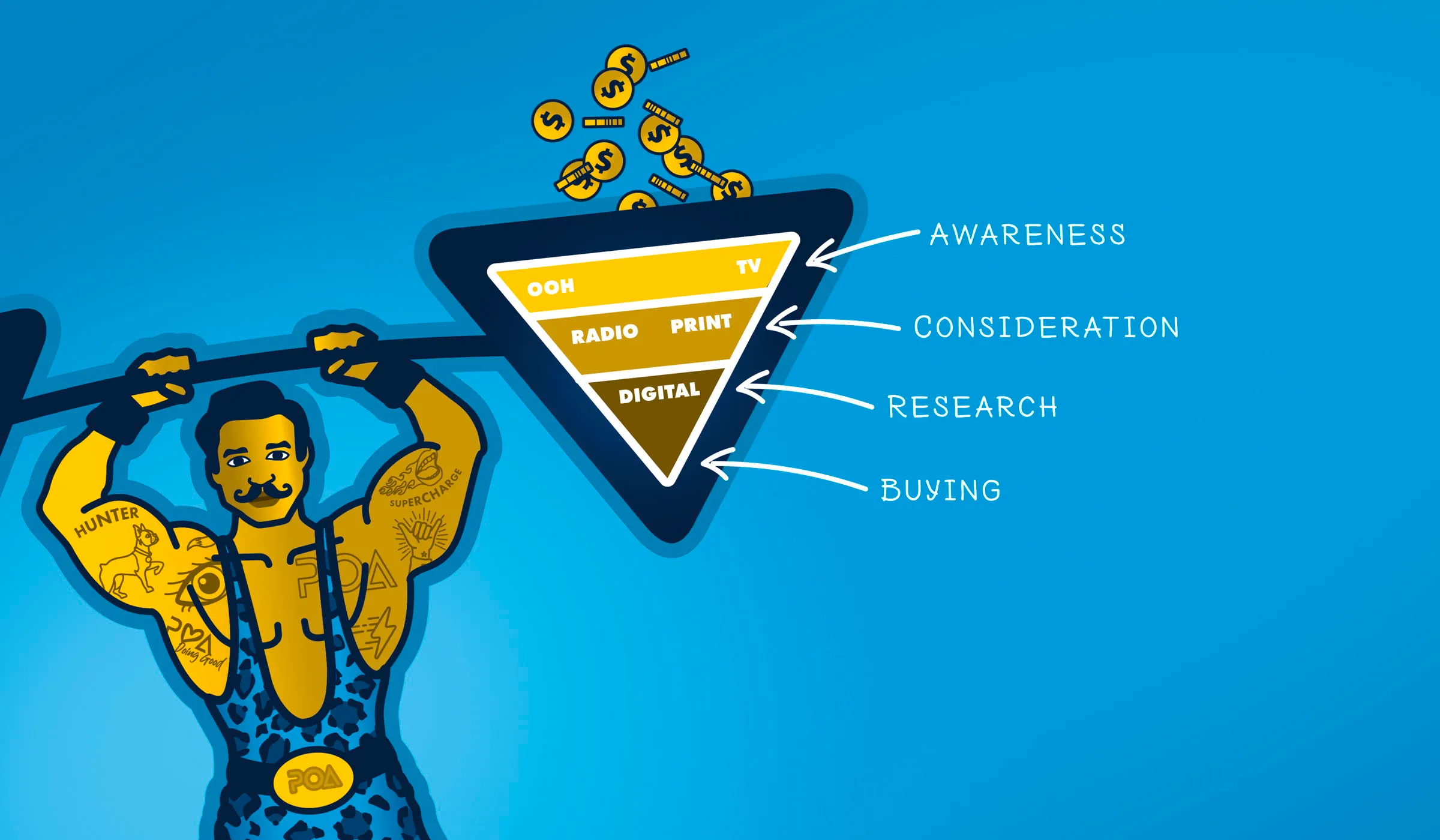
Unlike Google Ads or Meta, out-of-home isn't a dollar-in, dollar-out channel. It sits at the awareness stage of the funnel, feeding into consideration, research, and eventually purchase. Billboards are there to build awareness at scale, not to deliver a personalised solution.
That means billboard advertising will reach plenty of people outside your intended audience, and that's fine. It will also reach a large number of people who are your intended audience, and that's what fills the top of the funnel.
Match Your Measurement Plan to Your Campaign Goal
The metrics you track should follow the objective you set. Simply tracking generic marketing metrics (direct sales, enquiries, form submissions) undersells the impact of OOH advertising and misrepresents its position in the marketing funnel.
Awareness campaigns: track increases in branded search through Google Analytics and Google Search Console.
Retail and foot traffic: if you're a bricks-and-mortar business, look at in-store visits, map requests, and overall footfall.
Lead generation: track form submissions, phone calls, and CRM source attribution.
What you measure must align with the goals of the campaign. Positioning of advertising plays a key role in determining the metrics that you track. For instance, if you are looking to drive more direct form submissions, generate QR code scans, then using a billboard on a high-speed arterial road doesn’t match those goals. Conversely, if you’re looking to generate brand awareness, that positioning may be ideal. Billboard placement must align with campaign goals and the way that you measure impact must align with that campaign.
Track Direct-Response Signals During the Flight
Billboards punch above their weight for search activation
Research from the Nielsen OOH Online Activation Survey shows that billboards drive a disproportionately high share of search activity across all out-of-home formats.
Despite accounting for roughly 7% of out-of-home spend, billboards are attributed with around 26% of gross search activations.
Direct response signals – campaign-specific short URLs, call tracking, and QR codes – work well for tracking effectiveness in airports, shopping centres, and pedestrian areas. They're far less useful on high-speed roadside sites, where drivers can't safely scan a code or note a URL.
Use Industry Audience Data to Validate Exposure
Australia's MOVE system, run by the Outdoor Media Association, measures audiences across more than 150,000 outdoor sites nationally, covering five metro and 21 regional zones with hourly data across 180-plus demographic profiles.
Out-of-home advertising now reaches around 22 million Australians each week, roughly 97% of the population aged 14 and over.
Billboard Attribution vs. Causation
Another common mistake is skipping causal lift analysis.
Attribution tells you relative performance – which panel performed best, which creative or market drove more response. It doesn't prove causation.
Causal lift analysis builds a statistical synthetic control: a modelled prediction of what sales or visits would have looked like without the campaign, compared against actual results to isolate the real effect.
An AdQuick case study found that a banking app running an out-of-home campaign was able to attribute a 39% lift in new card subscriptions at a 98.7% confidence level.
Last-Click Attribution Undercounts The Impact of Billboard Advertising
Relying on last-click attribution is one of the most common mistakes in both out-of-home and digital advertising. If you always give credit to the final click, you ignore every step that got the customer there.
Last click assumes people see something once and then buy. That isn't how purchasing works, and the number of touchpoints varies significantly by purchase type:
Standard B2C retail: consumers typically see a brand six to 11 times before buying
High-ticket items: 15 to 25 touchpoints
Complex sales such as SaaS: 30 or more touchpoints
Out-of-home drives the awareness stage at the start of that sequence, well before the comparison and evaluation stages that last-click captures.
Measuring an out-of-home campaign properly means including first visits, new users, new form submissions, and all the early-stage activity that happens while a customer is still learning about the category.
Choosing the best advertising strategy for your business can be the difference between being memorable and being forgettable. You might have the best product or service in the country, but if no one knows about it, then you'll be missing out on sales. In an age where we all hear so much about Meta a
Read Article
Billboard advertising can be a cost-effective channel in your marketing mix - but it takes careful planning to balance the return on investment. Most small business owners see billboards as brand awareness tools, rather than conversion drivers. The reality is that billboards can drive both. This gui
Read Article
Billboard advertising and outdoor advertising continues to be one of the most effective ways for brands to reach prospective customers at scale. The latest data from 2025 published by the Outdoor Media Association (OMA) shows that out of home (OOH) advertising reaches 97% of Australians aged 1
Read Article
Billboard advertising (and by extension, out-of-home marketing) remains as effective at cutting through the noise as ever - billboard advertising statistics show that billboard advertising spend is increasing, and more companies are now including billboard advertising in their marketing mix in 2026.
Read Article
The outdoor advertising landscape in Australia has experienced rapid digitisation - in 2026, LED billboards are now commonplace in city centres, transport hubs, and along arterial roads. With digital advertising options coming into the spotlight, it raises the question of static billboards vs
Read Article